It is incredibly difficult for small or impromptu organizations to build sustainable digital infrastructure.
You start with a mission. You want to build a community, a co-op, or a small business. But quickly, you're managing a dozen subscriptions: Slack for chat, Google Workspace for docs, Asana for tasks, Shopify for sales, and a bank account that eats fees. And there's no way to manage who has access to what.
This is the SaaS Trap. Your data is siloed in walled gardens. Or there is no data at all. Your organization's identity is fragmented across ten different logins. And at any moment, a platform can raise prices or shut you down.
There is a better way. We call it the Cooperation Stack.
The Cooperation Stack
The Cooperation Stack is not a single app. It's a modular set of open protocols that you own, not rent.
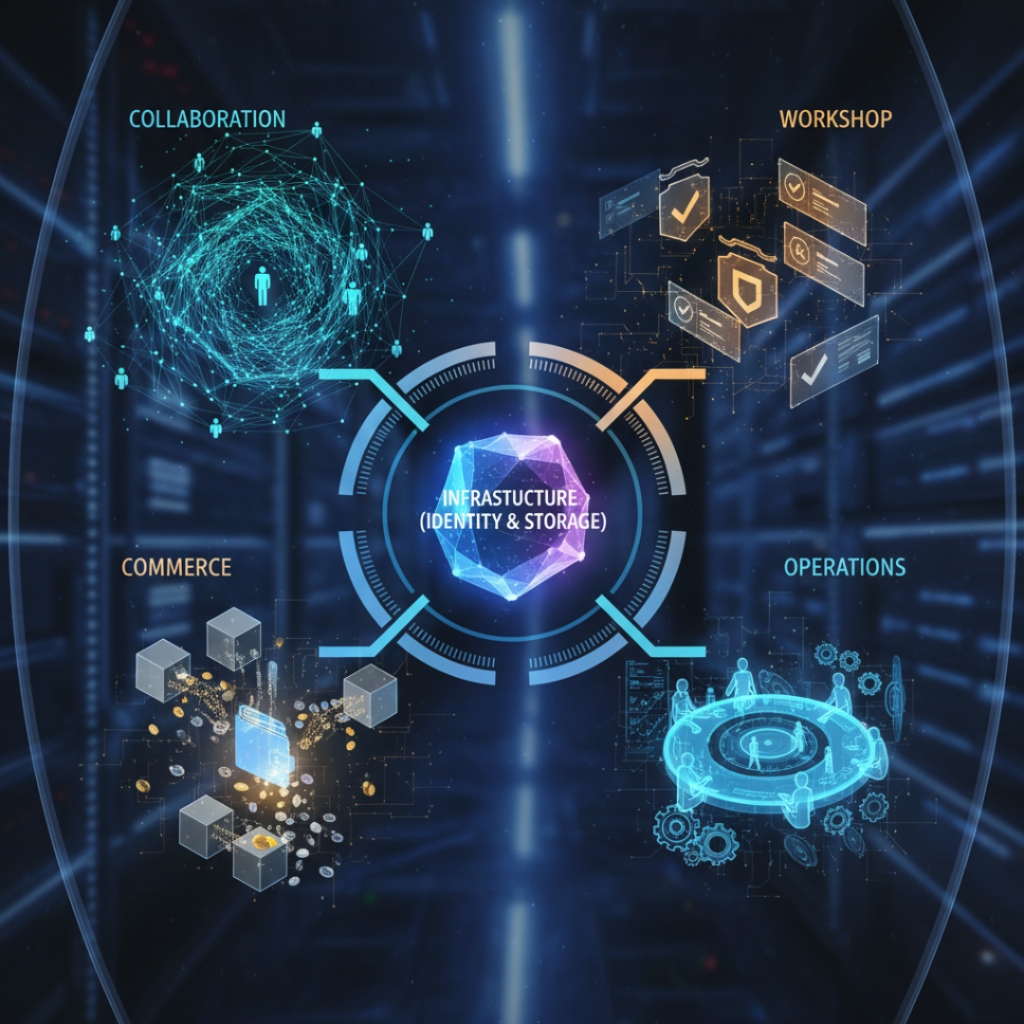
Graphic Description: A high-tech, HUD-style diagram of a digital ecosystem. Center Core: A glowing, crystalline structure representing Infrastructure (Identity & Storage). 4 Surrounding Quadrants: Top-Left: A mesh network of light streams (Collaboration). Top-Right: Glowing badges and task cards (Workshop). Bottom-Right: A holographic roundtable (Operations). Bottom-Left: Modular product blocks and coin streams (Commerce).
This stack is organized into a Core and Four Quadrants.
The Core: Infrastructure
At the center of everything is your digital sovereignty.
-
Identity:
In a small community, identity looks a lot like how people know and trust each other in a village, co‑op, or neighborhood group. Your identifier is your name and maybe your family or house (“Sam from the blue house by the church”), and your attributes are the things everyone associates with you: you are the person who runs the bakery, you’re on the volunteer fire brigade, you have a truck people can borrow, you speak Spanish, or you are known as reliable with kids. These shared facts and roles are the “who you are” layer, much like account details and group memberships in a digital system.
Credentials and authentication happen through social proof instead of passwords. If a newcomer wants to rent the community hall or open a tab at the local shop, they might need someone trusted in the community (a shopkeeper, elder, or neighbor) to vouch for them, or they might show a physical membership card for the co‑op. Authorization is about what someone is allowed to do once the community accepts who they are: the treasurer can access the group’s funds, the key‑holder can unlock the hall, and members of the gardening club can use the shared tools, while others cannot. Over time, behavior and reputation (showing up to meetings, paying debts, helping others) become part of that identity, influencing how much trust and access the community gives—just like activity history and risk signals do in digital identity systems.
Questions:
- Social Proof: "What mechanisms of social proof are the most humane?"
- Privacy: "How do reputation and behavior become selectively public while keeping details private?"
- Sovereignty: "Where is the data stored?"
- Censorship Resistance: "Can someone be deplatformed?"
- Portability: "If I leave this community, does my reputation come with me?"
- Recovery: "Who helps me recover my account if I lose my device?"
- Sybil Resistance: "How do we prevent one person from pretending to be ten people?"
- Selective Disclosure: "Can I prove I'm over 18 without showing my ID card?"
- Contextual Identity: "Can I keep my 'Professional' reputation separate from my 'Hobby' reputation?"
- Legacy: "What happens to my digital role and assets if I pass away?"
-
Action:
Identity is who you are; Action is what you do. This layer requires secure edge computing—a place where code can run on your behalf, 24/7, without exposing your private keys to the public internet.
This isn't just about API calls. It's about Agentic Workflows that bridge the old world and the new:
- Web Interaction: A headless browser logging into a legacy supplier portal, scraping inventory, and filling out order forms.
- Headless Android: A headless Android device running apps as your organization. It can send venmo, paypal, and use any android app.
- Telecommunications: A SIP server answering a phone call, transcribing the audio, and triggering a workflow.
- AI Processing: A local LLM analyzing sensitive contracts or processing data without sending it to a centralized cloud.
Where does it run? It happens in a Trusted Execution Environment (TEE). This could be a secure enclave on your own device, or a geolocalized VPS (Woven Node) that you control. The server acts as your digital proxy, executing complex tasks while you sleep.
Questions:
- Liability: "If my agent accidentally orders 10,000 units instead of 100, who pays?"
- Security: "How do I ensure my personal server hasn't been compromised?"
- Resource Management: "Who pays for the compute power to run these agents?"
-
Storage (The Vault):
- Instead of Google Drive (where Google owns the encryption keys), you use IPFS and Filecoin.
- The Upgrade: Tools like Helia and Web3.Storage make this feel just like a normal hard drive, but you control who can see the files.
- Questions:
- Data Sovereignty: "Where is the data stored?"
- Data Integrity: "How do I know the data hasn't been tampered with?"
- Data Availability: "How do I know the data is still available?"
- Data Security: "How do I know the data is secure?"
- Data Privacy: "How do I know the data is private?"
Quadrant 1: Collaboration (Top-Left)
How do you work together without a central server watching every keystroke? From messaging to document collaboration to video calls to file sharing, there are many ways to work together. The goal is to provide the lowest-cost and highest privacy available. And because groups and individuals are Woven members, they can set development goals and offer feedback on functionality.
Quadrant 2: The Workshop (Top-Right)
How do you track work and prove your skills without giving away your privacy? How do you weave together all the components of your systems?
Quadrant 3: Operations (Bottom-Right)
How do you make decisions and handle money? Personnel Management, budgeting, shared decision-making, and treasury management are all handled through the Cooperation Stack.
Quadrant 4: Commerce (Bottom-Left)
Finally, how do you sell to the world and keep people paid? Avoid the pitfalls of lock-in and fees on payment sites like Shopify and Etsy. Even squarespace and other no-code platforms will ratchet up their prices based on usage and ecommerce capabilities. This has to be a cooperative model like Woven to ensure the member's best interest is the primary goal, not profit.
Conclusion
For a small organization, the shift to the Cooperation Stack isn't just about technology. It's about sovereignty. It's about knowing that the community you build, the data you create, and the value you generate belongs to you.
The tools are here. The transition is happening. It's time to weave a new web.
Written by
irl.coop
hello@irl.coop